
Accessible Tools for Inclusive Cultural Practices | ZMINA:Resilience capacity building workshop #11
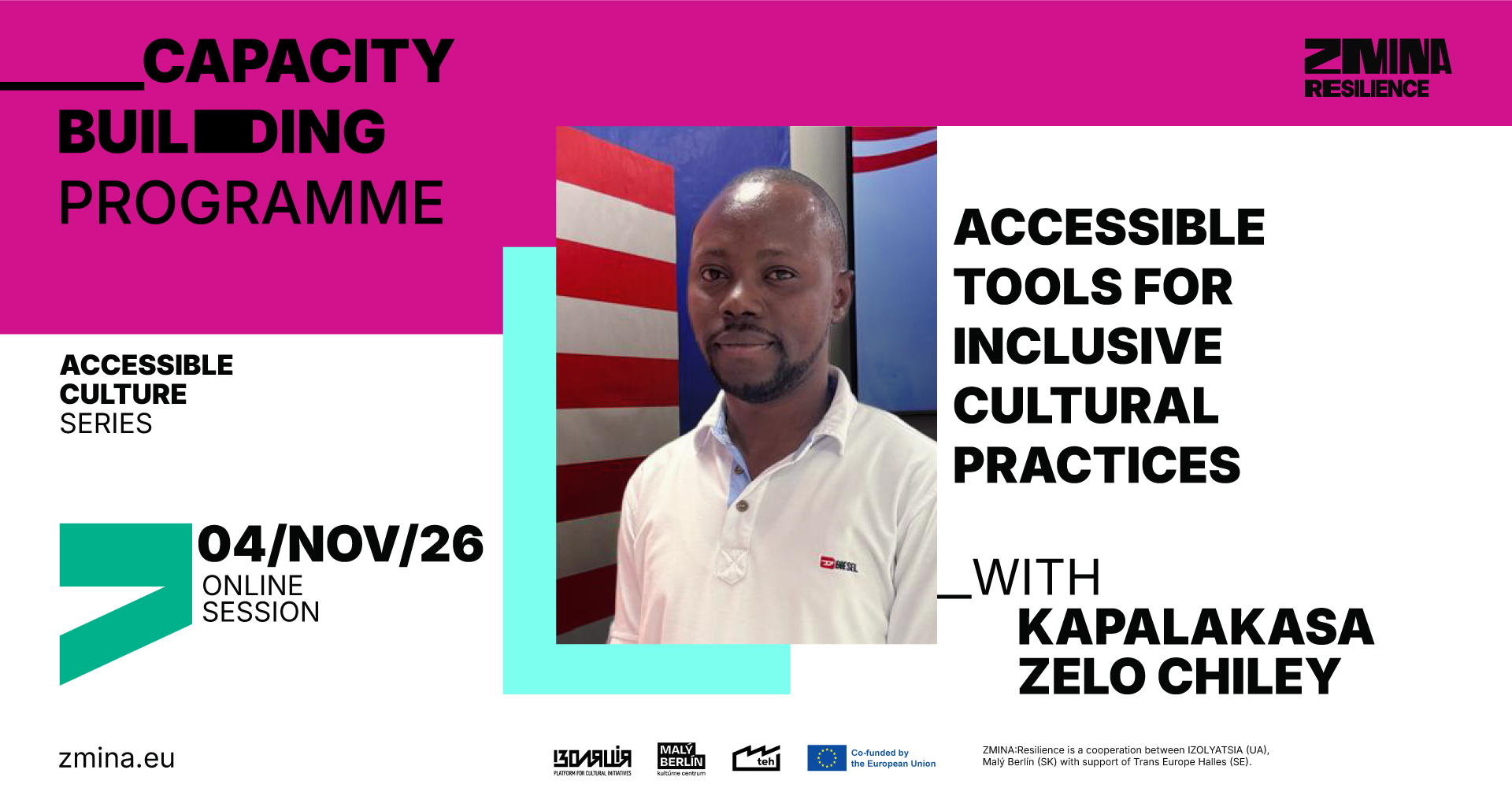
Too often, disability inclusion in the arts still means designing activities for people with disabilities, rather than with them — and assuming what they need instead of asking.
This session, led by Kapalakasa Zelo Chiley of Refugee Together for Social Transformation (RTST) in Uganda, offers a practical alternative. Drawing on years of work with refugees, particularly refugees with disabilities, and vulnerable communities in Kampala, the session shows how arts and creative activities — from storytelling and music to movement and crafts — can become genuine spaces for self-expression, confidence-building and social connection when people with disabilities are actively involved in shaping them. Participants will explore concrete, low-resource ways to adapt activities, materials and communication to different needs and environments, then put the approach into practice through a short interactive exercise.
🗣️ Trainer: Kapalakasa Zelo Chiley
Kapalakasa Zelo Chiley is a Congolese refugee from the Democratic Republic of the Congo who has lived in Uganda since 2016. He is the Founder and Executive Director of Refugee Together for Social Transformation (RTST), a refugee-led organisation based in Kampala, Uganda, supporting refugees and vulnerable communities with a particular focus on refugees with disabilities. Kapalakasa brings lived experience of displacement together with practical experience in refugee protection, disability inclusion, education, livelihoods, advocacy and community empowerment, and is passionate about using participatory approaches, arts and creativity to promote inclusion, accessibility, dignity and meaningful participation. Since 2020, RTST has reached over 2,000 refugees and vulnerable community members in Kampala, with around 510 people currently receiving active support through its programmes.
📌 Key takeaways:
- Design with, not for: why involving people with disabilities directly in shaping activities matters more than assuming what they need.
- Arts as a tool for connection: how storytelling, music, movement and crafts support self-expression, confidence and community participation.
- Practical adaptation, even with limited resources: simple approaches for making cultural activities accessible, tested through a hands-on exercise.
The training session will be held in English.
📅 Wednesday, 4 November | 13:00 – 15:00 CEST
ℹ️ For more information check out zmina.eu
▪ ▪ ▪
ZMINA:Resilience is a cooperation between IZOLYATSIA (UA), Malý Berlín (SK) with support of Trans Europe Halles (SE).
Co-funded by the European Union. Views and opinions expressed are however those of the author(s) only and do not necessarily reflect those of the European Union or European Education and Culture Executive Agency (EACEA). Neither the European Union nor the granting authority can be held responsible for them.